

SaaS content marketing is a repeatable system for creating content that attracts people with the problem your software solves, earns their trust, and moves them toward a trial, demo, purchase, renewal or expansion.
For startup founders, that definition matters. The goal isn’t to publish more blog posts. It’s to build a small set of content assets that reliably bring in qualified demand and compound over time, whether your buyers are searching from New York, London or Sydney.
In this guide, you’ll learn:
- What SaaS content marketing is, and why B2B SaaS content works differently
- How to nail your positioning and ideal customer profile before you write a word
- How to build a SaaS content strategy and map it to the full customer journey
- Which topics, formats and SEO practices actually drive signups
- How to use AI responsibly, distribute every asset and measure what matters
- A 90-day content plan you can start this week
It’s the same approach we use with SaaS founders at GoDigital World, so everything here is built to be put into practice, not just read.
What Is SaaS Content Marketing?
Content marketing uses useful assets (articles, videos, templates, tools, webinars, case studies and product documentation) to attract, educate and retain an audience. In SaaS, every one of those assets should connect to your buyer’s job to be done: the specific outcome they “hired” your software to deliver.
Why SaaS content marketing matters for startups
Unlike paid ads, content is an owned asset. Switch off your Google Ads or LinkedIn campaigns and the leads stop the same day. A strong guide, comparison page or template, by contrast, can keep bringing in search traffic and signups long after it’s published.
That makes content marketing especially valuable for early-stage startups with limited budgets. The trade-off is time: content needs patience and consistent distribution before it starts to compound. If you’re deciding whether to build that engine in-house or outsource it, this breakdown of how much SaaS blog writing services cost will help you budget realistically.
How B2B SaaS content is different
Most content marketing stops at the sale. B2B SaaS content can’t, because revenue is recurring: your customer decides to buy once, then decides again at every renewal whether to stay.
That’s why strong B2B SaaS content covers the whole customer journey:
- Discovery: helping buyers understand the problem they’re facing
- Evaluation: helping them compare approaches and tools
- Onboarding: helping new users get value quickly
- Adoption: helping teams build your product into their daily workflow
- Renewal and expansion: showing customers how to get even more value
It also has to work for more than one reader. The team lead who finds your article is rarely the person who approves the budget, so your content needs to give them the arguments to make the case internally.
Start With Positioning and Your Ideal Customer
Before you create a single piece of content, get clear on who you serve, the painful problem you solve, why your approach is different, and what you want the reader to do next. Skip this step and you’ll end up with a blog that tries to appeal to everyone and converts no one.
Write your positioning statement
Use this simple formula:
We help [specific buyer] achieve [desired outcome] without [main pain point], using [core differentiated capability].
Every piece of content you publish should reinforce that statement rather than chase every possible audience. Positioning sits at the heart of all effective branding and marketing strategies for success, and your content is where that positioning gets tested in public.
HubSpot’s guide to creating a SaaS marketing plan makes the same point: start with buyer personas, competitor research, goals, channels, budget and measurement before you produce any content.
Define your ideal customer profile (ICP)
Your ICP should include:
- Company profile: size, industry, geography and tech stack
- Buyer role: their responsibilities and the metrics they’re judged on
- Trigger event: what makes them start searching for a solution
- Alternatives and objections: what else they’re considering, and what holds them back
- Their language: the exact words they use to describe the problem
Geography earns its place on that list. A buyer in the US, UK or Australia may describe the same problem in different words, compare you against different local competitors, and expect pricing in their own currency, so capture those differences early.
Example: A workflow-automation SaaS might target operations managers at 20–200-person companies who are drowning in manual handoffs. Its content should tackle process bottlenecks, tool sprawl, approval delays and ROI, not generic “productivity tips.”
How to Build a SaaS Content Strategy
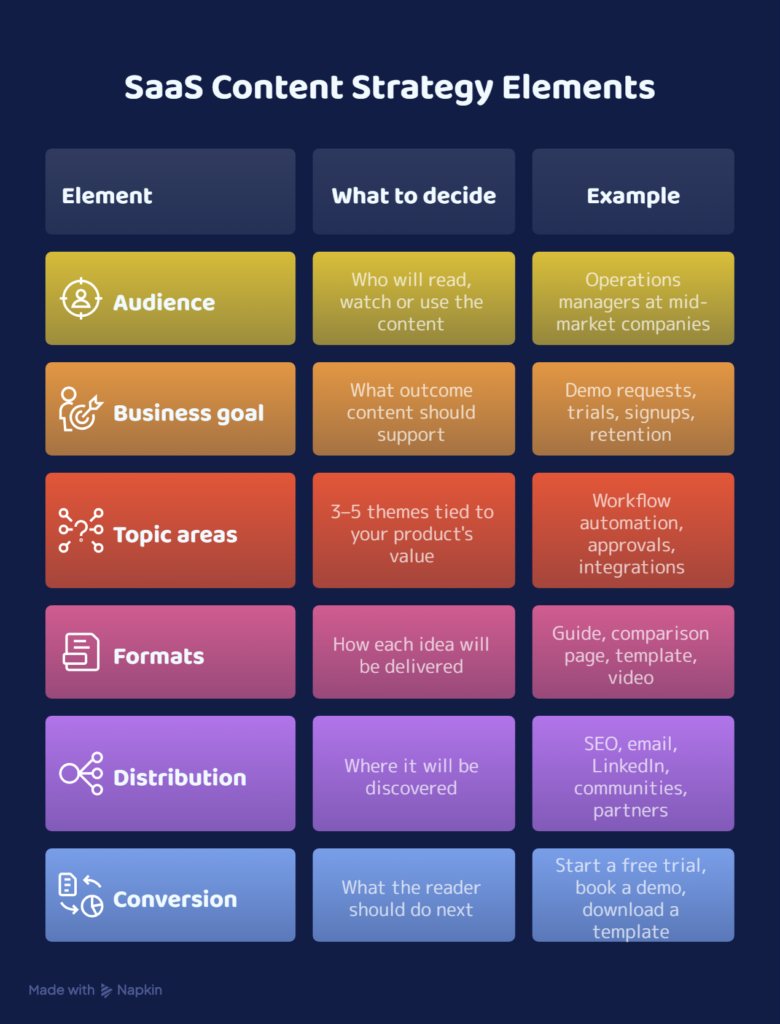
A practical SaaS content strategy for a startup has five core parts: audience, goals, topics, formats and distribution. Add a sixth, conversion, and every piece of content has a clear job to do. This process is often called content mapping: aligning each asset to a persona and a stage of the buyer journey.
Element | What to decide | Example |
Audience | Who will read, watch or use the content | Operations managers at mid-market companies |
Business goal | What outcome content should support | Demo requests, trials, signups, retention |
Topic areas | 3–5 themes tied to your product’s value | Workflow automation, approvals, integrations |
Formats | How each idea will be delivered | Guide, comparison page, template, video |
Distribution | Where it will be discovered | SEO, email, LinkedIn, communities, partners |
Conversion | What the reader should do next | Start a free trial, book a demo, download a template |
Judge each element against business outcomes, not publishing volume. The Content Marketing Institute’s B2B content marketing research found that the metrics B2B marketers most commonly use to measure content performance include conversions, email engagement, website traffic, website engagement and social media analytics. Traffic is on that list, but it’s never the goal on its own.
If you’d rather have this strategy built and run for you, our done-for-you SaaS blog writing services cover keyword research, content mapping, writing and on-page SEO every month.
Map Content to the SaaS Customer Journey
SaaS content should cover the full customer journey, not just top-of-funnel education. That journey usually runs from discovery and education, through a trial or demo, into activation, adoption, renewal and expansion. Here’s how to match content to each stage:
Journey stage | Buyer question | Content type | Conversion goal |
Awareness | “What’s causing this problem?” | Educational guides, explainers, research, social posts | Email signup or return visit |
Consideration | “What approaches or tools exist?” | Comparison pages, alternatives pages, buyer’s guides, webinars | Trial or demo |
Decision | “Is this the right solution for us?” | Case studies, ROI calculators, security pages, pricing explainers | Demo, trial, purchase |
Onboarding | “How do I get value quickly?” | Setup guides, templates, tutorials, checklists | Activation |
Retention | “How do we get more value?” | Use cases, release notes, advanced workflows, customer stories | Renewal and expansion |
HubSpot’s guide to content for every funnel stage describes the funnel as a way to organize content around where a prospect is in their buying journey, from first recognizing the problem through to purchase, and recommends matching each piece to the buyer’s questions, doubts and goals at that stage.
Three takeaways for founders:
- Start close to the decision. If budget is tight, comparison pages, alternatives pages and case studies usually turn into trials faster than broad educational posts.
- Don’t stop at awareness. Many startup blogs are almost entirely top-of-funnel explainers, which bring in visitors who aren’t ready to buy.
- Keep creating after the sale. Onboarding and retention content helps customers succeed, and customers who succeed are the ones who renew and upgrade.
Choose High-Impact Topics With Topic Clusters
Start with three to five core topic areas that map directly to your product’s value and to what your buyers search for. Build one pillar page for each topic, then create supporting articles that answer narrower questions and link back to the pillar. This hub-and-spoke structure helps readers move between related content and shows Google that your site covers the topic in depth.
Here’s how a topic cluster might look for a customer-support SaaS:
- Pillar: Customer Support Automation: The Complete Guide
- Supporting content: How to Reduce First Response Time · AI Support Ticket Triage: How It Works · Zendesk vs. Intercom · Customer Support SLA Template
- Product-led content: How to Automate Ticket Routing in [Product]
- Decision content: Customer Support Software Pricing Guide · Best Support Tools for Small Teams
One warning: don’t choose topics only because they have search volume. Prioritize topics where your product has a credible point of view, the searcher has a real problem, and there’s a natural next step from the article to your product. A keyword with modest volume and strong buying intent will usually beat a popular keyword your product can’t help with.
For more examples of how SaaS teams structure their topics, this SaaS content marketing breakdown is worth a read.
The Best Content Formats for Software Companies
Blog posts still matter, but they shouldn’t be your only format. In content marketing for software companies, buyers evaluating solutions often need use-case pages, comparison pages, integration pages, templates and bottom-of-funnel articles before they’re ready to commit.
The formats that consistently pull their weight:
- Problem-solving guides: explain how to achieve an outcome, with practical steps and examples.
- Comparison and alternatives pages: help buyers weigh their options honestly, including where your product isn’t the best fit.
- Use-case pages: show how a specific persona solves a specific problem with your product.
- Templates and calculators: give immediate value and generate qualified leads.
- Case studies: lead with the customer’s outcome, then explain the workflow and results.
- Product-led content: teach a task and show how your product makes it easier.
- Short video and social content: repurpose insights from long-form assets for LinkedIn, YouTube and communities.
- Webinars and podcasts: build authority and open conversations with prospects.
HubSpot’s roundup of the most effective B2B SaaS marketing tactics specifically highlights customer stories that lead with outcomes, along with product-led content tied to the jobs your buyers need done. For more ideas by format, this overview of content marketing for SaaS is a useful companion read.
Make SEO Work for Your SaaS Content
SEO should help buyers find answers at the moment they need them, not trick search engines into ranking thin pages. Google’s guidance on creating helpful, reliable, people-first content explains that its systems aim to prioritize helpful content and look at signals of experience, expertise, authoritativeness and trustworthiness (E-E-A-T), with trust being the most important. The same guidance stresses originality, substantial and complete coverage, useful analysis, and being clear about who created the content, how and why.
These principles hold whether you’re targeting Google in the US, the UK or Australia. For each market, add region-specific examples, competitors and pricing wherever they genuinely help the reader.
A 7-step practical SEO process
- Research demand: find the questions buyers ask before, during and after evaluating a solution.
- Cluster keywords: group related searches around one pillar topic.
- Match intent: use guides for informational searches, and comparison, pricing or alternatives pages for commercial ones.
- Create a better asset: add original frameworks, screenshots, templates, expert input, product examples or proprietary data.
- Optimize the page: use a clear title, descriptive headings, a concise introduction, internal links and a relevant CTA.
- Build authority: earn links and mentions through original research, expert contributions, partnerships and genuinely useful resources.
- Update regularly: refresh outdated statistics, screenshots, competitor details and product instructions.
How to Use AI Without Losing Trust
AI can speed up research, outlining, drafting, repurposing and analysis, but it shouldn’t replace subject-matter expertise or customer evidence. Google’s guidance on AI-generated content is clear: it rewards original, high-quality content that demonstrates E-E-A-T, however that content was produced.
A safe AI workflow for SaaS content looks like this:
- Use AI to research angles, build outlines and produce first drafts.
- Have a domain expert check every claim, add real examples and fix inaccuracies.
- Add screenshots, customer quotes, data and product-specific workflows.
- Disclose meaningful AI assistance where appropriate, and keep editorial accountability with a named author.
- Never publish a generic article that could appear on any SaaS blog.
Distribute Every Asset
Publishing is only half the work. Every major asset needs a distribution plan across owned, earned and paid channels:
- SEO: optimize for relevant buyer searches and internally link related pages.
- Email: send new guides to segmented lists and nurture leads with related resources.
- LinkedIn: turn each article into a founder point-of-view post, carousel, short video or discussion prompt.
- Communities: share genuinely useful answers in relevant Slack groups, Reddit threads and industry forums, without spamming.
- Sales enablement: give your sales team comparison pages, case studies, ROI tools and objection-handling content.
- Partners and integrations: co-create content with complementary tools to reach shared audiences.
- Paid promotion: amplify content that has already proven itself organically to lookalike or high-intent audiences.
HubSpot’s B2B SaaS marketing guide recommends choosing channels based on your buyer journey and growth model, whether that’s product-led, sales-led or hybrid, and treating content and SEO as a way to capture high-intent demand over time. For a deeper look at how B2B teams plan this, see this guide to B2B SaaS content marketing.
Measure What Matters: SaaS Content KPIs
Track a small set of metrics tied to pipeline and customer outcomes. Traffic is useful, but it isn’t the goal. For a startup, conversions, qualified leads, pipeline, activation, retention and revenue influence matter far more.
Metric | What it tells you |
Organic sessions and rankings | Whether your content is discoverable |
Engagement time and scroll depth | Whether the content is genuinely useful |
Email signups and content downloads | Whether it generates demand |
Trial starts, demo requests, signups | Whether it drives acquisition |
MQLs, SQLs, pipeline and revenue | Whether it supports sales |
Activation and retention | Whether content helps customers succeed |
Content-assisted conversions | Whether content contributes across the whole journey |
The Content Marketing Institute’s annual B2B content marketing benchmarks, budgets and trends research is a useful reference for how other B2B teams budget for and report on content.
Set targets by funnel stage. Illustrative example only: “Publish 12 bottom-of-funnel comparison pages in 90 days, generate 100 demo requests, and attribute 20% of new pipeline to content-assisted conversions.” Your own targets should reflect your traffic, sales cycle and deal size.
A 90-Day SaaS Content Plan for Founders
If you’re starting from scratch, here’s a practical 90-day plan to get your SaaS content marketing off the ground.
Days 1–30: Build the foundation
- Interview 5–10 customers and lost prospects.
- Define your ICP, buyer personas, positioning and core messaging.
- Identify 3–5 topic clusters.
- Audit existing content and spot the gaps.
- Set up analytics, CRM tracking, UTM conventions and conversion goals.
- Publish one pillar page and 3–5 supporting articles.
Days 31–60: Create demand assets
- Publish two high-intent comparison or alternatives pages.
- Create one template, calculator, checklist or free tool.
- Produce one customer story or proof-based asset.
- Build an email nurture sequence tied to your pillar topic.
- Repurpose each asset into LinkedIn posts, short videos and sales collateral.
Days 61–90: Optimize and scale
- Review rankings, traffic, engagement, conversions and pipeline.
- Update underperforming pages with a better intent match, stronger evidence and clearer CTAs.
- Double down on the topics and formats producing qualified demand.
- Add internal links between related assets.
- Create a repeatable workflow for briefs, editing, publishing and promotion.
Common Founder Mistakes to Avoid
- Publishing generic thought leadership with no connection to buyer problems.
- Chasing keywords without considering commercial intent or product fit.
- Creating only top-of-funnel blog posts and neglecting comparison, pricing and use-case pages.
- Treating content as a one-time publishing task instead of an ongoing distribution system.
- Measuring traffic without connecting content to trials, demos, pipeline or retention.
- Making claims without customer evidence, original data or expert review.
- Using AI to produce volume rather than to improve research, clarity and scale.
SaaS Content Marketing FAQs
How long does SaaS content marketing take to work?
Most SaaS startups see early signals, such as rising impressions and rankings, within the first few months. Meaningful traffic, trials and demos usually build over six to twelve months, depending on your site’s authority, competition and publishing consistency.
What’s the difference between B2B SaaS content and regular content marketing?
B2B SaaS content serves longer buying cycles and multiple decision-makers, and it continues after the sale with onboarding, adoption and retention content, because recurring revenue depends on customers staying.
Should startups start with SEO or LinkedIn?
Ideally, both. SEO builds long-term, compounding traffic, while LinkedIn gives faster visibility and founder-led trust. If you can only pick one, start with bottom-of-funnel SEO content and share every piece on LinkedIn.
Can AI write SaaS content?
AI can speed up research, outlines and first drafts, but content that ranks and converts still needs human expertise, real examples, customer evidence and careful editing.
Final Thoughts
SaaS content marketing isn’t about publishing more. It’s about building a focused system: clear positioning, content mapped to every stage of the customer journey, SEO that serves real buyers, and distribution and measurement tied to revenue. Start small, stay consistent and let it compound.
Want posts like this every month?
Get done-for-you SaaS blogs, from $1,200/month. We handle keyword research, strategy, writing and on-page SEO, so you can get back to building your product.
Explore our SaaS blog writing plans or get in touch with GoDigital World to talk through your content goals.
Found this useful? Let me write SEO blogs for your business.
Planned, written, and shared on 5-6 social platforms every month. Try one blog for $250.