
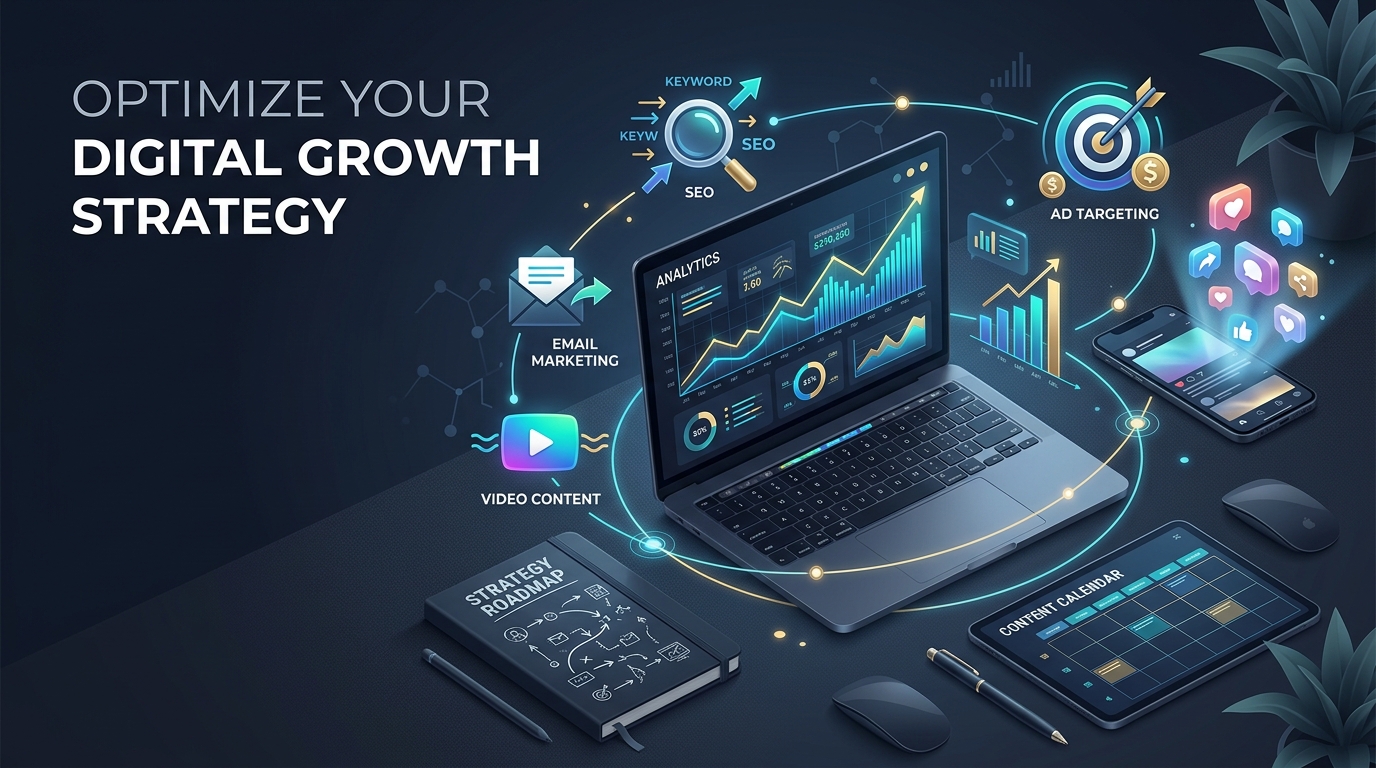
Most businesses don’t have a digital marketing strategy — they have a list of tactics. A few social posts here, a boosted ad there, an email blast when sales dip. That approach might have limped along a few years ago, but in 2026 it simply doesn’t work. Third-party cookies are gone, AI-powered search results are answering questions before anyone clicks a link, and audience attention is scattered across more platforms than ever. Businesses that treat marketing as a connected system — not a grab bag of tactics — are the ones pulling ahead.
🎥 Prefer watching instead of reading?
Watch the full step-by-step explainer video below.
This guide walks through a complete, step-by-step framework for building a digital marketing strategy that actually drives revenue, not just activity. Whether you’re building your first plan or rebuilding one that’s stopped working, you’ll find a practical structure to follow. If you’d rather have a team build and run this strategy for you, agencies like The Go Digital World specialize in exactly this kind of end-to-end strategy work. And if you want to go deeper on any single piece of this framework, we’ve broken out dedicated guides on channel selection, content strategy, and 2026 trends elsewhere in this series.
What Is a Digital Marketing Strategy (and Why It Matters More in 2026)?
A digital marketing strategy is the operating system behind your marketing — the plan that connects your positioning, your offers, your channels, your content, your data, and your team into one coherent effort aimed at measurable business outcomes. It’s different from a digital marketing plan, which is the tactical, day-to-day execution of that strategy. Strategy is the “why” and “what”; the plan is the “how” and “when.”
Why Strategy Matters More Now
Three shifts are forcing this change:
- Privacy rules are stricter and third-party cookies are gone, so tactics built on broad-audience retargeting no longer deliver the returns they once did.
- AI search and zero-click results are changing how people discover brands — showing up in an AI Overview matters as much now as ranking #1 used to.
- Attention is fragmented across more platforms than any single team can chase, so brands need a system for prioritizing where to show up, not a reflex to be everywhere.
Strong, well-documented positioning and branding make every one of these problems easier to solve — it’s worth reading up on branding and marketing strategies built for long-term success before you start picking channels or writing content.
The 4 Questions Every Strategy Must Answer
Before you touch a single channel or campaign, your strategy needs clear answers to:
- Who are you trying to reach?
- What do you want them to do?
- How will you reach them?
- How will you know it’s working?
If you can’t answer all four in a sentence or two, you’re not ready to spend budget yet.
Step 1 — Set Measurable Business Objectives
Most marketing plans start with tactics (“let’s run some ads,” “we need to post more”) instead of numbers. Flip that. Start with revenue and work backward.
Working Backward from Revenue Targets
Ask, in order:
- How much revenue do you need marketing to generate?
- What conversion rates can you realistically expect, based on your own historical data or industry benchmarks?
- How much traffic or how many leads does that require?
- What investment — budget, time, tools — is needed to generate that volume?
This backward-planning approach turns a vague goal like “grow the business” into a number you can actually plan a budget and channel mix around. If you’re not sure where your current numbers stand, a free audit is often the fastest way to find out — you can see the full range of strategy and audit services offered here.
SMART Goals + Leading Indicators
Set goals that are Specific, Measurable, Achievable, Relevant, and Time-bound — but don’t stop there. Add leading indicators: weekly traffic trends, monthly conversion rates, quarterly pipeline contribution. These early signals let you course-correct in week three instead of discovering a problem at the end of the quarter. In 2026, every marketing action should be justifiable against real business impact, not “we should have a presence there” or “it’s trending.”
Step 2 — Understand Your Audience: Personas and Journey Mapping
Channels and content only work when they’re built around real people, not assumptions. This is where most strategies quietly fall apart.
Building Data-Driven Personas
Modern personas go well beyond age, job title, and location. A useful persona captures:
- Goals and challenges
- Preferred information sources and content formats
- Decision-making process and emotional drivers
- The typical buying journey and common objections
Build these from CRM records, website analytics, direct customer interviews, sales team insights, social engagement, and support conversations — not guesswork. Agencies managing multiple client accounts often lean on platforms like ResellReady to keep this kind of client and audience data organized across accounts. Keep it to 3–5 primary personas; more than that and your team loses focus trying to serve everyone at once. Revisit personas quarterly, since buyer behavior shifts faster than most teams update for.
Mapping the Non-Linear Customer Journey
Customer journeys in 2026 rarely move in a straight line. People bounce between devices, platforms, and channels before converting. For each stage — awareness, consideration, decision, retention, and advocacy — document:
- The questions and emotional state your customer has at that point
- Where they go for information
- The specific action you want them to take next
Pay closest attention to the transition points between stages. That’s where most journeys quietly break down — someone reads a blog post but never opens an email, or downloads a guide but never books a call — and it’s where fixing one small gap often lifts conversion more than any new channel would. This is also where channels like social media prove their worth for re-engagement; if you’re weighing whether social fits your mix, it’s worth reading how a social media marketing agency approach can support each journey stage. If you’d rather talk through your specific audience and journey with a strategist directly, you can book a free consultation call here.
Step 3 — Choose the Right Digital Marketing Channels
Not every channel deserves your budget. The businesses that win in 2026 aren’t the ones present everywhere — they’re the ones present deliberately, where their audience already spends time.
Four Criteria for Channel Fit
Before adding any channel to your digital marketing plan, run it through four filters:
- Audience presence — Are your actual target customers active there, or just active users in general?
- Competitive intensity — Can you realistically earn attention, or are established players crowding you out?
- Content fit — Does the channel support the formats your audience prefers and your team can produce consistently?
- Measurability — Can you track this channel’s real contribution to revenue, not just impressions?
A channel that fails two or more of these is a distraction, not a strategy.
Typical Channel Mixes for B2B vs. B2C
- B2B businesses typically see the strongest returns from SEO, content marketing, email nurturing, LinkedIn, and paid search — channels built around longer consideration cycles and trust-building.
- B2C businesses generally lean harder into SEO, the specific social platforms their audience actually uses, email, influencer and creator partnerships, and paid social.
Social remains one of the most misunderstood channels in either category — teams often either over-invest or ignore it entirely. It’s worth reviewing how established social media marketing firms structure their channel mix before deciding how much weight to give it in your own plan.
Balancing Organic vs. Paid (The 60-70/20-30/10 Rule)
Organic channels like SEO and content compound over time but take months to mature. Paid channels deliver traffic immediately but stop the moment spend stops. A reliable starting allocation:
- 60–70% of budget to proven, already-performing channels
- 20–30% to emerging channels worth testing
- 10% to genuine experiments
Review this split quarterly and shift budget toward whatever’s actually converting — not whatever felt exciting last quarter. (For a deeper breakdown of channel selection frameworks, see our dedicated channel strategy guide.)
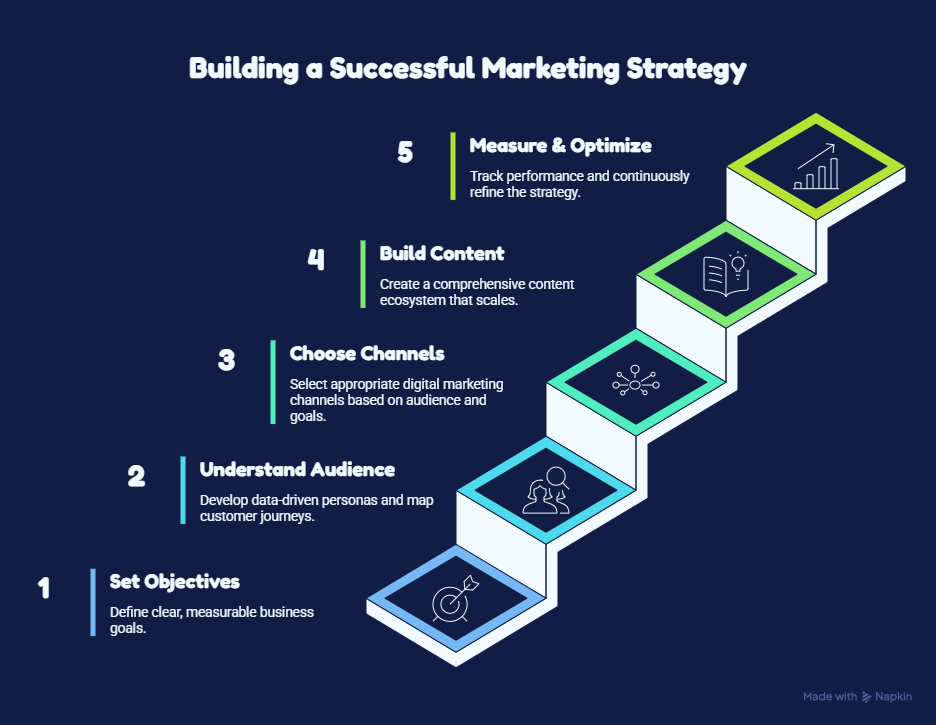
Step 4 — Build a Content Ecosystem That Scales
Channels are the roads; content is what actually moves people down them. Without a content system, even a perfect channel mix has nothing to carry.
Pillar-Cluster Content Strategy
This very guide is a working example of the model: a comprehensive pillar page (this post) anchoring a cluster of related, deeper posts on channels, content, trends, and measurement. Structuring content this way builds compounding SEO value, creates natural cross-linking opportunities, and signals topical authority to both readers and search engines — which matters as much for traditional Google rankings in the US, UK, and Australia as it does for how AI-driven search summarizes your brand.
Planning Content for the Full Funnel
Most brands overload the top of the funnel with blog posts and starve the middle and bottom. A complete content ecosystem includes:
- Case studies and comparison guides
- Product demos and technical documentation
- ROI calculators and implementation guides
If you’re building content specifically to package and sell — courses, templates, guides — it’s worth seeing what’s currently working; ResellReady’s breakdown of digital marketing products for small business owners and their guide to digital products worth selling in 2026 are both useful starting points.
Distribution and Repurposing
Content that no one sees is wasted spend. Build distribution across:
- Owned channels — website, email, social profiles
- Earned channels — PR, guest posts, industry publications
- Paid channels — social ads, syndication, sponsored placements
Repurpose every major asset into multiple formats — blog excerpts, social graphics, email content, video scripts, infographics — to multiply the return on a single piece of content. (Our content strategy cluster post covers repurposing workflows in more detail.)
Step 5 — Measurement, Analytics, and Continuous Optimization
A strategy without measurement is just a hope. This is where most of the “did it actually work” questions get answered — or avoided.
Building a Metrics Hierarchy
Define success in layers, from the top down:
- Business metrics — revenue, profit, market share
- Marketing outcomes — pipeline, customers acquired, retention rate
- Channel metrics — traffic, leads, engagement by channel
- Operational metrics — content velocity, campaign launch time, testing velocity
Each layer should ladder up to the one above it. If a channel metric looks great but never shows up in marketing outcomes, something in the chain is broken.
Multi-Touch Attribution Over Last-Click
Last-click attribution undervalues everything that happened before the final touchpoint — which, in a non-linear 2026 customer journey, is most of the work. Data-driven or position-based attribution models give a far more honest picture of which channels actually deserve credit and budget. As detailed in Girard Media’s 2026 strategy framework, moving off last-click is one of the most common fixes that immediately changes how teams allocate spend.
Creating a Testing Culture
Systematic testing should run across:
- Landing pages and email campaigns (A/B tests)
- Complex page layouts (multivariate tests)
- Messaging and format experiments
- Channel budget allocation and audience targeting
Document every test’s hypothesis, method, and result in a shared knowledge base. Over time, this record becomes a genuine competitive advantage — most competitors are still guessing.
2026 Trends Your Strategy Needs to Account For
Trends should serve your strategy, not distract from it. Adopt only what actually fits your objectives and audience.
AI as Infrastructure, Not a Gimmick
AI now sits underneath content personalization, workflow automation, and predictive analytics — powering dynamic content tailored to behavior, churn and conversion forecasting, and AI-assisted creative testing. But generic, unedited AI content still underperforms; strategic, brand-aligned use wins, a distinction Deloitte Digital’s 2026 marketing trends report also highlights as separating leaders from laggards this year.
Zero-Click Search and AI Overviews
With AI-generated search summaries now answering many queries directly, brands need to optimize for concise, structured answers, strong schema markup, and “answer-first” content that earns visibility even before a click happens.
Privacy-First and Zero-Party Data
Third-party cookies are gone for good. What’s replacing them: first-party data from email, SMS, and loyalty programs, zero-party data collected through quizzes and gated content, and clean consent practices that avoid steering campaigns blindly. Commerce Pundit’s trend roundup lists this shift toward owned data as one of the most consequential changes for 2026.
Short-Form Vertical Video
Short-form video across TikTok, Reels, and Shorts continues to lead discovery, trust-building, and conversion — and by most projections, it remains the dominant content format across nearly every industry this year.
Creator-Led and Community Growth
Micro-influencers and long-term creator partnerships are consistently outperforming one-off celebrity endorsements, with more brands investing in ongoing relationships and community-driven spaces on platforms like Discord and Substack. Influencity’s guide to crafting a 2026 strategy and this breakdown of social marketing strategies shaping today’s world both go deeper on building these creator relationships the right way.
A Practical 6-Week Roadmap to Launch Your Strategy
Turn this framework into action with a structured six-week rollout, an approach also outlined in Digitalised.io’s guide to building an effective 2026 strategy:
Week | Focus | Key Actions |
1 — Clarify | Foundations | Define KPIs, personas, core promise, differentiation, and priority offer |
2 — Audit | Reality check | Review channel performance, tracking consistency, CRM quality, and sales-marketing alignment on lead quality |
3 — Instrument | Data setup | Set up consent, event tracking, conversions, and a single source-of-truth dashboard |
4 — Redesign | Conversion | Improve messaging, proof, landing pages, offers, and nurture sequences |
5 — Test | Validation | Run test cycles on messaging, offers, pages, and targeting |
6 — Stabilize | Scale | Lock in budget allocation, editorial calendar, review rituals, and a plan to scale proven levers |
Common Mistakes to Avoid in 2026
- Confusing activity with impact — publishing and sponsoring without tying it to business KPIs creates noise, not growth.
- Channel obsession — channels amplify a strategy; they can’t compensate for a weak offer or unclear message.
- Underestimating tracking debt — unreliable data collection leads to unreliable decisions and reactive budget shifts.
- Naive AI use — AI without a clear angle, proof points, and brand voice just speeds up producing interchangeable content.
Bringing It All Together
A digital marketing strategy isn’t a single campaign, channel, or trend — it’s the system connecting all of them to a measurable business outcome. Get the foundation right — clear objectives, real audience data, deliberate channel choices, a scalable content ecosystem, and honest measurement — and the tactics underneath it get dramatically easier to execute.
Explore each step in more depth in our cluster series on channel selection, content strategy, and 2026 marketing trends — or follow The Go Digital World on LinkedIn for ongoing strategy breakdowns.
Get a free marketing audit and see exactly where your current strategy is leaking revenue.
Subscribe to our newsletter for weekly, no-fluff digital marketing strategy insights.
Frequently Asked Questions
- What’s the difference between a digital marketing strategy and a digital marketing plan?
A digital marketing strategy is the overarching “why” and “what” — your objectives, audience, and channel priorities. A digital marketing plan is the tactical execution of that strategy: specific campaigns, content calendars, and timelines. You need the strategy first; the plan follows from it. - How long does it take to see results from a digital marketing strategy?
Paid channels can show measurable results within weeks, while organic channels like SEO and content marketing typically take 3–6 months to gain traction and longer to compound fully. That’s why most effective strategies blend both — quick wins from paid to fund the runway organic needs to mature. - Which digital marketing channels should a small business start with?
Start with the channels where your audience already spends time and that you can measure reliably — for most small businesses, that means SEO, email, and one or two social platforms rather than trying to be active everywhere at once. Expanding channel mix should follow proven traction, not trends. - How much should a business budget for digital marketing in 2026?
Budget depends heavily on industry and growth stage, but a useful starting split is 60–70% toward proven channels, 20–30% toward emerging ones, and roughly 10% toward experiments — reviewed and adjusted quarterly based on what’s actually converting. - How is AI changing digital marketing strategy in 2026?
AI is now embedded in content personalization, predictive analytics, and workflow automation rather than being a standalone tactic. It also affects strategy indirectly through zero-click search and AI Overviews, which reward structured, answer-first content over traditional keyword-stuffed pages.
This guide was put together by the team at The Go Digital World, specializing in SEO blog content and Facebook Ads management for growing businesses. If you’re looking for hands-on help building out your content strategy or scaling paid social campaigns, connect on LinkedIn — happy to talk through what’s working right now.
🎬 Want a visual walkthrough?
If you’d rather watch than read, here’s the full explainer video covering everything in this guide: